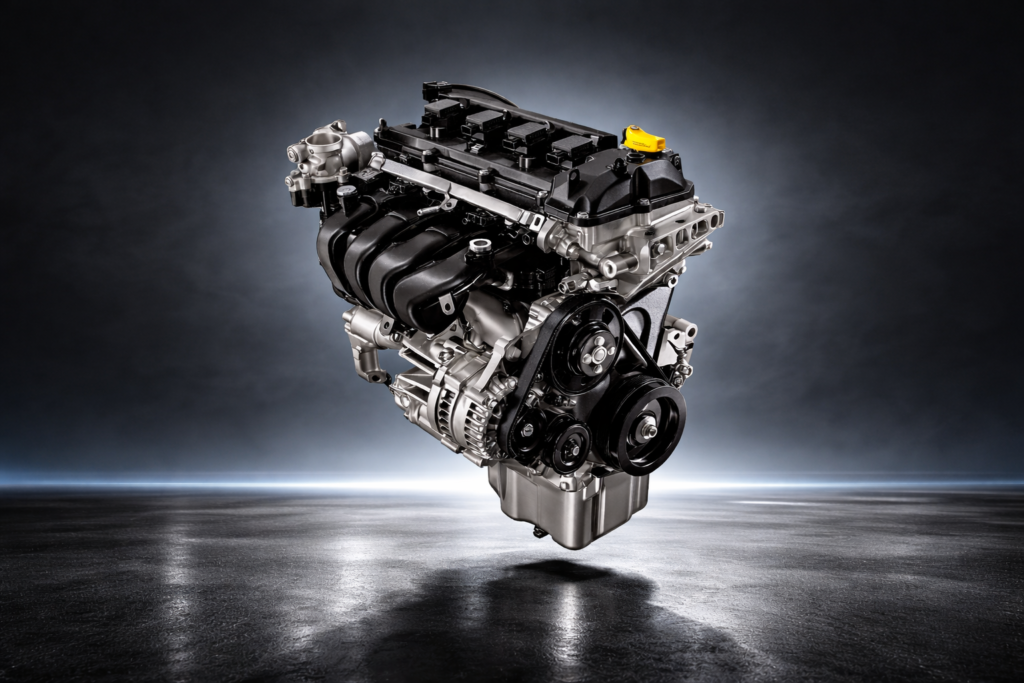
Final days for the 1.2 litre 4 cylinder engine of Maruti Suzuki “The K12N legend”.
History
Code named as “K12N”, this typical 4-cylinder engine made Suzuki the master of mileage, reliability and maintenance. The K-series of engines was introduced by Suzuki way back in 2009 to replace their ageing G – series engines, which were not mileage-friendly. The first K-series engine was the K12M which had a single injector setup and was not a hydrid focused engine, since in 2010 hybrids were not a viable option for auto manufacturers in India and the market was flooded with many diesel engines which were cost effective and maintainance friendly thanks to Fiat’s 1.3 litre multijet diesel engine which was officially ” the national engine of India”. In 2019, the BS4 and BS6 norms were kicking in and the world started to phase out the diesel engines this made Suzuki to completely switch it’s dependency on pure Petrol engines as a result K12N was born as the successor to K12M with the infamous Dualjet technology (2 injectors) and can be coupled to a torque assist motor to act as a hydrid. This engine made Maruti Suzuki outshine the competition with Models like Swift, Dzire, Baleno, Wagnor and Ignis topping the sales chart for years.
Nightmare for the Competition
Though brands like Tata and Mahindra invested more in safety features and 5 star ncap ratings. But to cut the engine cost, they only offered 3-cylinder engines, which were not smooth and less mileage-effective.
Whereas Maruti Suzuki solely relied on its K12N engine, which outclassed the competition and made Maruti the market leader in the small car segment. Even Hyundai, known for its 4 cylinder kappa series engine, couldn’t sell enough i20s, i10s and Eterrs to match Maruti’s market share. Kappa series engines from Hyundai are smooth and reliable, but in terms of fuel efficiency and performance, they are not even close to the K12N. K12N is renowned for its low and mid-range performance, which is best for city traffic and also has decent top-end torque, which makes it an all-rounder in city, hills and Highway conditions. Honda’s 1.2 L iVTEC engine also suffers the same fate as Hyundai’s. This makes the K12N market leader in the 1.2L engine category.
Entry of EVs
No matter how good you are, there is always someone better to replace you. Entry of affordable EVs in the small car segment, like Tata Tiago, Tigor and Punch, to challenge the K12N’s supremacy in the market. With increasing fuel prices and climate change, EVs are the only viable solution in the long run to tackle these issues. Even though there are a lot of concerns regarding the battery life and resale value of an EV. Auto manufacturers are shelling out various schemes like BAAS (Battery as a Service) and life long warranty on battery packs to tackle these drawbacks.
All major brands are pushing towards the EV solution by reducing their dependency on traditional internal combustion engines.
Maruti Suzuki Z12E engine
Thanks to brands like Tata and Mahindra for pushing the safety awareness in the indian car market. Earlier, an Indian customer chose a car only on the basis of reliability and maintainance but now everyone has started to ask the question “how safe is it?”. This has made legacy brands like Maruti Suzuki enter the safety features spectrum. Generally, for a manufacturer to make a car that is reliable as well as qualifies the 5 star rating under 10 Lakh, they have to compromise on any one of the factor either the engine or the build quality. That’s the reason why many 5-star rated cars have only a 3-cylinder engine under 10 lakh.
Thus, the Z12E 3-cylinder engine was born in Suzuki’s R&D lab in Japan. Now Suzuki can focus on the build quality by cutting short on the engine cost. Recently launched Maruti Suzuki Dzire in 2024 attained 5 star rating in NCAP, with the Z12E engine marking the entry of Maruti into the safety-seeking consumer market. Suzuki has done the same to the iconic Swift. At the end of 2026, even Baleno, Fronx and Wagnor models will get the Z12E engine, which has already completed the testing phase and is due for launch. 2026 will be the last production year for the K12N engines; that’s the sad reality.
Future push – The Hybrid vs EV war
So what will happen to the Z12E engine in the long run once the K12N disappears? Will EVs rule this small car segment by throwing out the Z12E? Well, this cannot happen; no company will phase out a new product without recovering the investment costs it has made for the product. Suzuki has invested close to 1450 crore to develop the Z12E engine, so it’s impossible for Suzuki Motors to sideline it for EVs. Instead, Suzuki is planning to use the Z12E engine in standalone hybrids just like Toyota which switched to hybrids when the entire world was going EVs. Toyota is the market leader in Hybrid tech, from plug-in to standalone hybrids. Don’t forget that Toyota holds a significant share in Suzuki Motors Japan, and already the two giants are in a rebagging partnership to capture the Indian mass market under 10 Lakh. With Toyota’s hybrid tech, Maruti Suzuki will give nightmares to the competition in the small car segment. Already, there are reports of the Fronx getting the hybrid Z12E variant, and testing is in progress. Definitely, there is going to be a war between hybrids and EVs in the coming years. As a consumer, it’s a boon for us; with more competition, we get good products at a reasonable price.
Thus, in a2zreviews, we have given you insight into the future of the small car segment in the Indian car ecosystem. Kindly share our content and do comment to show us your support. We are an independent platform focused on buyers, not on brands.