
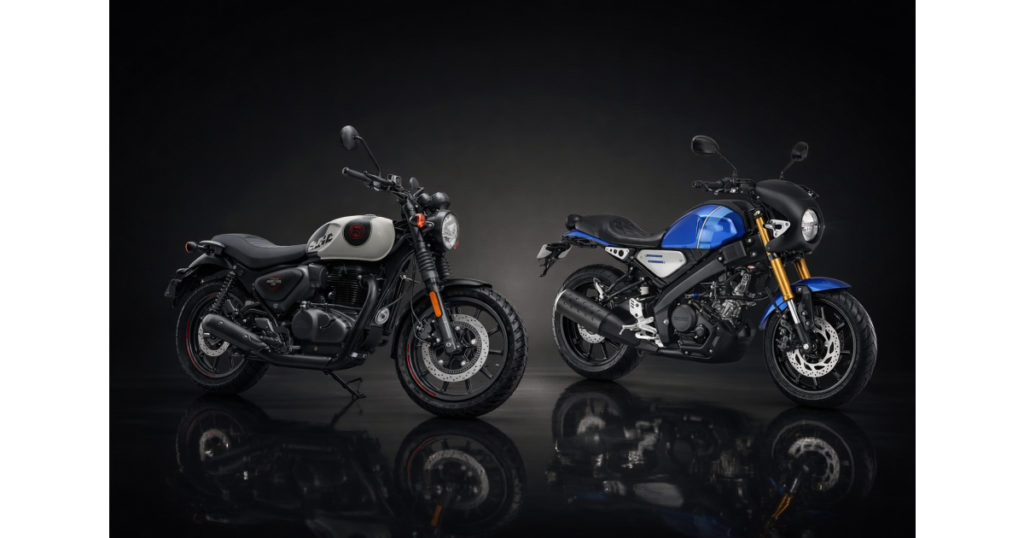
Today’s two-wheeler market is full of overpriced motorbikes across all segments. Under 2 lakh budget, if you are looking for a street-friendly machine with decent looks and average rear seat comfort, accompanied by an engine that doesn’t drink much Petrol for the miles it munches. Then you have two budget-friendly machines with a value-for-money tag. Though comparing a 350cc motor to a 155cc doesn’t logically prove correct, in terms of price, both these motorcycles are in the same price band, targeting the same set of people. So let’s see how they compare.
1. Engine Performance
Hunter 350
- Engine: 350cc air-cooled
- Power: 20.2 bhp @ 6100 rpm
- Torque: 27 Nm @ 4000 rpm
- Camshaft design: SOHC
- Gearbox: 5 speed
- City usage: 4 stars
- Highway usage: 3 stars
Hunter’s 350cc motor produces 20.2 bhp of power and 27 Nm. Though the engine seems powerful on paper, it’s long stroke nature, combined with SOHC design produces its maximum torque in the first 3 gears itself, which is very much ideal to ride in city traffic, but lacks the top-end punch in 4th and 5th gears, making it sluggish in highway cruise as the engine struggles to reach and maintain the 100 kmph mark.
Royal Enfield Hunter 350 is a perfect city commuter with limited highway usage, as the engine is not a rev-happy one. Above 6000 rpm, vibrations in handlebar and footpegs are notable, but at 80-90 kmph speed, the engine is stress-free. The 5 speed gearbox is not as smooth as the Japanese one, but it does the job. With 27 Nm torque in a twist of the throttle, Hunter launches like a rocket.
With maximum power delivered in the first 3 gears, downshifts are not required for sudden overtakes. Heat dissipation from the engine to the legs in traffic is quite evident due to the air-cooled setup, but it is manageable. End of the day, Hunter has an engine capable of surviving in both cities as well as on highways with adequate power and torque.
Yamaha XSR 155
- Engine: 155cc liquid cooled
- Power: 18.1 bhp @ 10000 rpm
- Torque: 14.2 Nm @ 7500 rpm
- Camshaft design: SOHC
- Gearbox: 6 speed
- City usage: 5 stars
- Highway usage: 2 stars
155 cc mill from Yamaha is underpowered with 14.2 Nm torque, and the XSR is just a sitting duck before the Hunter. But wait, this engine is silent and smooth as it revs madly to 10000 rpm without much vibration. Yamaha’s decades of experience in engine technology have created a small, silent monster. XSR handles the city traffic like a cakewalk with Liquid Cooling; the heat dissipation is well maintained, and the 14.2 Nm torque is adequate for city runs. But you need frequent downshifts for overtakes, which the 6 speed gearbox is ready to do all day with butter-smooth shifts.
In highway cruise, Yamaha XSR 155 is very well underpowered, even though the engine revs madly, post 90 kmph, the engine loses its steam and does not wish to maintain the 100 kmph mark for a prolonged time.
So the XSR engine is definitely a city bird.
2. Ride and Handling
Hunter 350
- Front suspension: 41mm telescopic with 130mm travel
- Rear suspension: Twin shocks with 6-step adjustment
- Front brake: 300mm disc, twin piston
- Rear brake: 270mm disc, single piston
- Front tyre: 110/70, 17 inch
- Rear tyre: 140/70, 17 inch
- ABS: Non-switchable single channel (Dual channel on top variants)
- Ground clear clearance: 160mm
- Seating height: 790mm
- Kerb weight: 181 kg
- Pillion comfort: 4 stars
The Hunter comes with an upright riding position that feels comfortable in both city traffic and on highways. The wide handlebars give you a relaxed posture, and the twin shock absorbers do a good job of handling rough roads. On top of that, the Hunter offers some of the best pillion comfort in its segment, especially for riders in their mid-40s, helped by the easy-to-manage 790 mm seat height.
Hard rubber component tyres from Ceat lack the grip while braking, which can be switched to soft ones. Braking is well balanced and adequate, but not providing Dual channel ABS in the lower variants of Hunter is a cost-cutting gimmick from RE.
For tall riders above 6 ft, Hunter is a small bike. Hunter does not support off-roading due to its 160mm ground clearance. With 181 kg kerb weight, Hunter is not a light bike, and can be difficult to manoeuvre in the city traffic, but for highway cruising at speeds above 90 kmp Hunter is as stable as a rock and is not affected by crosswinds.
Yamaha XSR 155
- Front suspension: 37mm USD forks with 130mm travel
- Rear suspension: Link-type monoshock with 97mm travel
- Front brake: 282mm disc, twin piston
- Rear brake: 220mm disc, single piston
- Front tyre: 100/80, 17 inch
- Rear tyre: 140/70, 17 inch
- ABS: Non-switchable dual channel
- Ground clearance: 170mm
- Seating height: 810mm
- Kerb weight: 137 kg
- Pillion comfort: 2 stars
XSR is more of a cafe racer. Yamaha should have given clip-on handlebars on it, but the seating position is upright and relaxed. For a solo rider, XSR’s seating position is more comfortable than Hunter but the pillion comfort is nowhere near Hunter’s. The narrow, fat rear seat is not adequate for two well-built adults. The suspension in XSR is on the harder side compared to the soft and cushioning effect in Hunter.
Yamaha offers dual channel ABS in all its variants. MRF tyres in XSR offer better braking than the Ceat ones in Hunter. For a short rider, XSR is a little uncomfortable as the seat height is 810mm. XSR has limited off-roading capabilities thanks to its 170 mm ground clearance. Due to its 137 kg kerb weight, XSR is very easy to manoeuvre in city traffic, but for highway cruising, it wobbles due to cross winds at speeds above 90 kmph. For solo riders, XSR 155 is a better option than Hunter.
3. Mileage and Maintenance
Hunter 350
- ARAI mileage: 36.2 kmpl
- Yearly service cost: Rs 6500 average
- Maintenance cost: 2 stars
️Even though RE has service points across India, feedback from customers on RE service quality is not positive. Overpriced accessories, fragile spare parts, and a lack of skilled technicians have damaged RE’s service reputation. Frequent issues in Hunter are its rusting, sprocket damage before 5000 kms, engine oil leak in gaskets and ABS sensor clogging issues. Real-world mileage of Hunter is around 30-35 kmpl in cities and 35-40 kmpl on highways.
Yamaha XSR 155
- ARAI mileage: 45.5 kmpl
- Yearly service cost: Rs 4500 average
- Maintenance cost: 3 stars
The service quality of Yamaha has a mixed response among users. Japanese technology is known for its reliability and low maintenance. Wear and tear of Yamaha spares is low compared to RE. Yamaha has used the same VVA (Variable Value Actuation) Engine technology in XSR, similar to R15 and MT15, which optimises performance and mileage. Due to its 155cc engine, the service and maintenance cost of XSR is more pocket-friendly than that of the Hunter. Real-world mileage of XSR is 38-42 kmpl in cities and 45-47 kmpl on highways.
From the above details, we can conclude that in terms of performance and handling, Hunter 350 shines, and in maintenance and reliability, Yamaha XSR 155 takes the front seat. So, my reader, if you are willing to spend more on performance and handling, then the Hunter 350 is your choice, but if you want a pocket-friendly bike with minimal maintenance and adequate performance, the XSR 155 is the right choice for you.
In a2zreviews, we are focused on providing knowledge to our readers who are going to be future buyers. This forum was started with pure grit to help buyers before making their choice, and we are not backed by any brand or organisation, as this forum is exclusively for end-users.
️
️
️