
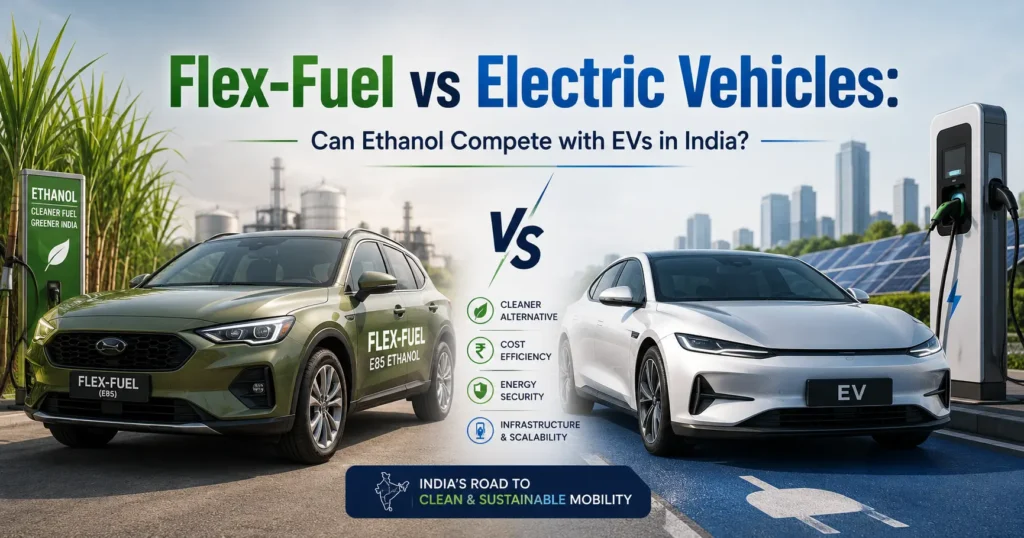
Indian auto-mobile industry is running after two new technologies today. First one is Electric vehicles, which most of us are already familiar with and some of you may be owning one already. The second one is Flex-fuel vehicles, which is relatively new and most of you may not be familiar with.
For a potential buyer, knowing the difference between the two and how the Indian automobile landscape is getting reshaped with their emergence is of utmost importance. That is what we are trying to tackle with in this article.
What are Flex-Fuel Vehicles and Why are they Being Compared with EVs?
Flex-fuel vehicles (FFVs) are vehicles capable of running on Petrol or a mix of Ethanol and Petrol. The Ethanol-Petrol ratio can vary from E20 to E85 (85% ethanol and 15% petrol) to even E100. The specifically designed composition sensors in these vehicles automatically adjust fuel injection based on the fuel blend. This flexibility in adapting to any ethanol-petrol blend is what makes FFVs the new talk of the town.
Now, to answer the question as to why FFVs are being compared with electric vehicles, FFVs, like EVs, are our way to reduce dependence on fossil fuels. For a country as big as India, reducing reliance on gasoline is no small feat. We need to embrace different new technologies to make it possible at a gradual pace. FFVs and EVs are India’s way to secure an energy-sufficient future.
Why India Is Investing in Both EVs and Ethanol?
India’s transport sector relies heavily on imported crude oil, making fuel security a major concern. To reduce oil imports and lower emissions, the government is pursuing multiple alternative fuel strategies rather than depending on a single technology.
Electric vehicles (EVs) are being promoted to reduce tailpipe emissions and support cleaner urban mobility. At the same time, ethanol-blended and flex-fuel vehicles help utilise domestically produced biofuels derived from crops such as sugarcane and maize.
The government’s approach is not EV versus ethanol. Instead, both technologies are being developed simultaneously to reduce fossil fuel dependence, improve energy security, and offer consumers different pathways toward cleaner transportation.
Flex-Fuel vs EV: Head-to-Head Comparison
Purchase cost
Flex-fuel vehicles are expected to be priced similarly to conventional petrol cars, with only minor modifications required to support higher ethanol blends. This could make them more affordable for buyers transitioning from traditional internal combustion vehicles.
EVs typically have a higher upfront cost because of their battery packs. Although prices have been gradually declining, many electric cars still cost more than comparable petrol-powered alternatives.
Running cost
EVs generally offer the lowest running costs due to the lower price of electricity compared to petrol or ethanol fuels. Maintenance costs are also lower because electric powertrains have fewer moving parts.
Flex-fuel vehicles may reduce fuel expenses if ethanol remains cheaper than petrol. However, ethanol contains less energy per litre, which can result in lower fuel efficiency and partially offset fuel-price advantages.
Infrastructure
India’s fuel station network already covers most parts of the country, giving flex-fuel vehicles a significant advantage once higher ethanol blends become widely available.
EV charging infrastructure is expanding rapidly, but remains concentrated in cities and major highways. Charging accessibility can still be a concern in many regions.
Convenience
Flex-fuel vehicles can be refuelled within minutes, similar to conventional petrol cars. Drivers do not need to change their travel habits significantly.
EV owners typically need to plan charging sessions, especially during long-distance trips. Home charging offers convenience for some users, but it is not available to everyone.
Environmental impact
EVs produce zero tailpipe emissions and can significantly reduce overall emissions when powered by cleaner electricity sources.
Flex-fuel vehicles still emit carbon dioxide during operation, but ethanol is considered a renewable fuel because the crops used to produce it absorb carbon dioxide during growth. As a result, lifecycle emissions may be lower than those of conventional petrol vehicles.
Challenges Faced by EVs and FFVs
Electric vehicles have gained considerable momentum in India, but several challenges continue to affect their adoption. The most obvious barrier is the higher upfront purchase price compared with similarly sized petrol-powered vehicles.
While charging infrastructure is expanding, public charging stations remain unevenly distributed, especially outside major cities and highways. Charging time is another concern, as replenishing an EV battery takes significantly longer than refuelling a conventional vehicle.
Many potential buyers are also concerned about battery degradation and the long-term cost of battery replacement, even though modern battery technologies have improved considerably. Additionally, range anxiety- the fear of running out of charge before reaching a charging station- continues to influence buying decisions, particularly among drivers who frequently travel long distances.
Flex-fuel vehicles face several hurdles before they can achieve widespread adoption in India. The biggest challenge is the limited availability of high-ethanol fuel blends such as E85, which are currently not widely accessible across the country. Although India has made significant progress in increasing ethanol blending in petrol, the infrastructure required to support dedicated flex-fuel vehicles is still developing.
Another concern is fuel efficiency, as ethanol contains less energy per litre than petrol, meaning vehicles may consume more fuel to travel the same distance. In addition, large-scale ethanol production depends heavily on agricultural output, raising concerns about crop availability, water usage, and land allocation. Consumer awareness also remains relatively low, which may slow adoption until flex-fuel technology becomes more common in the market.
Which Technology Makes More Sense for Different Buyers?
Both technologies have their pros and cons when it comes to different types of buyers. Therefore, whether you should buy a flex-fuel vehicle or an electric vehicle depends on those conditions as well, in addition to the market trends. Here are a few different types of buyers and our suggestion on which kind suits them the best.
City commuter
For urban drivers with predictable daily travel distances, EVs often make the most sense. Lower running costs, quiet operation, and home charging convenience can deliver significant savings over time.
Highway traveller
Flex-fuel vehicles currently offer greater convenience for frequent highway travel because refuelling is faster and fuel stations are more widespread.
Apartment resident
Buyers living in apartments without dedicated charging facilities may find flex-fuel vehicles more practical until charging infrastructure improves.
Rural buyer
Flex-fuel vehicles are likely to be easier to adopt in rural areas where charging infrastructure remains limited. Existing fuel station networks provide a familiar ownership experience.
Long-term ownership buyer
The better choice depends on usage patterns. High-mileage drivers may recover an EV’s higher purchase cost through fuel savings, while lower-mileage owners may find flex-fuel vehicles more economical overall.
Can Ethanol Really Challenge EVs in India?
Ethanol is unlikely to replace EVs entirely, but it could become an important complementary technology. EVs currently offer superior energy efficiency and lower running costs, particularly in urban environments. However, flex-fuel vehicles can leverage India’s existing refuelling infrastructure and may appeal to buyers who are not yet ready to transition to electric mobility.
Rather than competing directly, EVs and flex-fuel vehicles may serve different segments of the market. EVs are likely to dominate city commuting and short-distance travel, while flex-fuel vehicles could remain attractive for long-distance driving, rural regions, and consumers seeking a familiar ownership experience.
India’s transportation future may ultimately involve a mix of technologies, with both EVs and ethanol contributing to reduced oil imports and lower emissions.