
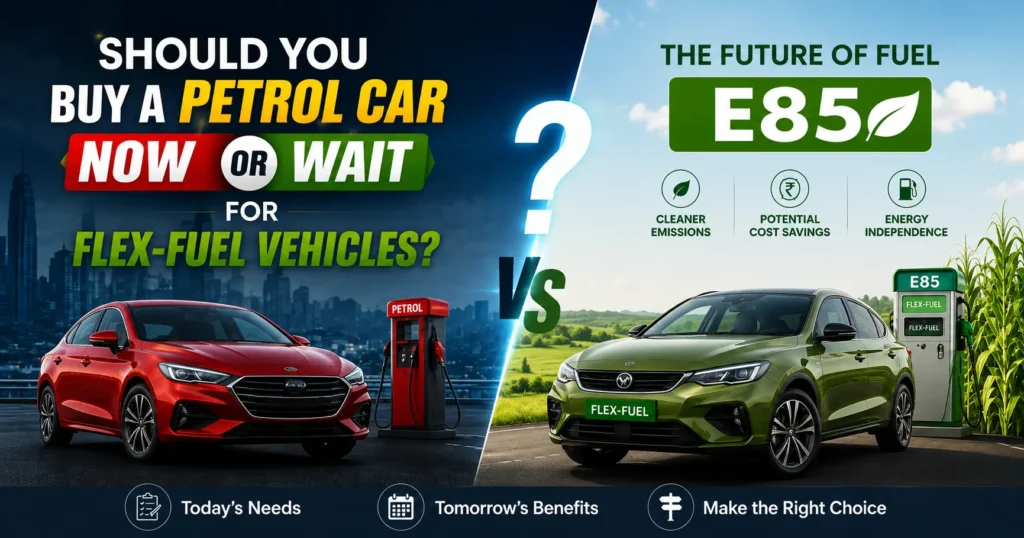
If you are inclined towards buying a petrol car over an EV and you are planning to buy it in the next 6 to 12 months, you may go ahead with purchasing the currently available E20 petrol vehicle. Although India is actively promoting ethanol-based fuels, the flex-fuel vehicle choices and fuel availability are still in their developing stage. Hence, for most buyers, an E20-compliant petrol car remains the more practical option today.
What are Flex-fuel Vehicles?
Flex-fuel vehicles, or FFVs, are vehicles having an engine that can run on more than one type of fuel, contrary to the engines currently in wide use. These engines work with the help of a fuel detection sensor that detects the different fuel proportions inside the fuel tank (e.g., ethanol and petrol) to optimise their ignition timing and fuel injection rate.
Why India is Pushing Ethanol?
Adoption of bio-fuels like Ethanol has been one of India’s longstanding goals to achieve self-sufficiency in its fuel requirements. This was only accelerated by the ongoing Iran-US war, which is creating havoc in oil imports and causing distress to the Indian economic landscape. Moreover, choosing a biofuel future is the right direction for a highly populated country to minimise its environmental risks caused by fossil fuels.
Current Status of Flex-fuel Cars in India
With the launch of Maruti Suzuki Wagon R – India’s first flex-fuel passenger car, on June 5th 2026, India is headed towards a greener future. WagonR is capable of running on ethanol-petrol blends varying from E20 to E100. Other flex-fuel cars geared up for launches are Maruti Suzuki Fronx, Toyota Innova Hycross, Tata Punch, Hyundai Creta, and Mahindra XUV 3XO.
How Flex-fuel Cars Differ from Regular Petrol Cars
The major differences between flex-fuel cars and petrol cars are engine hardware and fuel efficiency. The regular petrol cars widely in use today only run on E20 fuel, which is a mix of up to 20% Ethanol and 80% petrol. Fuel with a blend of over 20% ethanol will lead to corrosion, fuel system damage, and performance issues over time.
This is where flex-fuel vehicles come into the picture. The engine mechanism of flex-fuel vehicles equips the fuel tank to hold any proportion of Ethanol and Petrol, like E30, E85 and even up to E100, which is purely ethanol, without causing any damage to the vehicle.
When it comes to the fuel efficiency of the FFVs, the regular petrol vehicles have an edge. Due to Ethanol’s lower energy per unit volume compared to Petrol, the mileage suffers a significant (up to 35%) drop when running on fuel with a higher percentage of Ethanol. Meanwhile, when it comes to power, Ethanol’s higher octane rating gives it a slight power boost compared to Petrol vehicles.
Possible Future Timeline of Flex-fuel Adoption In India
Flex-fuel adoption has become a major agenda for the Indian government in the wake of the ongoing tension in Western Asia. To reduce the impact of the situation in India, the government is giving a major push to Flex-fuel adoption, thereby gradually decreasing the reliance on crude oil imports. Here is a possible future timeline of the developments in the flex-fuel adoption in India.
| Year | Development |
| 2020 | E 20 draft release |
| 2025 | E 20 rollout is largely completed |
| 2026 | First flex-fuel passenger car launch & E85 pump expansion |
| 2027-2030 | Wider E85 availability |
| 2030+ | Increase in Ethanol blending targets to reach E100 |
How Will Flex-Fuel Adoption Affect the Resale Value of Cars?
This is a relevant question that should be answered in the context of buying a new car. Most car buyers who are buying a new car will take into account its resale value as a major decision factor. So the flex-fuel situation is sure to bring concerns and doubts among buyers about its impact on the resale value of their car.
E20 Petrol cars are predominant in the Indian market. Hence, this is the model we are taking into account now. As far as the resale value of the regular petrol vehicles is concerned, we need to look at the resale value impact on a short-term and long-term basis.
In the short term, which is roughly the next 3-5 years, widespread flex-fuel adoption is unlikely to significantly hurt the resale value of modern E20-compliant petrol cars in India.
In the longer term (5–15 years), resale values could be affected if:
- E85 fuel becomes widely available.
- Flex-fuel vehicles become common across price segments.
- Ethanol remains substantially cheaper than petrol.
- Government policies increasingly favour flex-fuel vehicles.
Why Petrol Cars May Hold Their Value for Years
Despite the emergence of flex-fuel technology, here are the most important reasons why petrol cars may retain their value over the years.
1. Millions of Petrol Cars Already Exist
India has tens of millions of petrol vehicles on the road.
Even if flex-fuel vehicles gain popularity, existing petrol cars won’t disappear overnight.
Think about diesel cars:
- Even after stricter emissions rules, diesel vehicles didn’t suddenly become worthless.
- Resale values adjusted gradually.
A similar pattern is likely with flex-fuel adoption.
2. Infrastructure Takes Time
A technology only affects resale value when buyers can actually use it.
If E85 pumps are available only in select cities, many used-car buyers won’t care whether a vehicle can run on E85.
As long as petrol remains widely available, conventional petrol cars should continue to have a large market.
3. Most Buyers Care About Price and Reliability
When purchasing a used car, buyers often prioritize:
- Purchase price
- Maintenance costs
- Reliability
- Fuel efficiency
Flex-fuel capability may not become a major selling point immediately.
When Resale Values Could Be Affected
Scenario A: Mild Impact (Most Likely)
Suppose:
- E85 becomes common by 2030–2035.
- Flex-fuel cars become mainstream.
In this case:
- Flex-fuel vehicles may command a small resale premium.
- Traditional petrol cars may depreciate slightly faster.
- The difference may be noticeable but not dramatic.
Scenario B: Significant Impact
Suppose:
- E85 is much cheaper than petrol.
- Fuel stations are widespread.
- Government incentives favour flex-fuel vehicles.
Then buyers may increasingly prefer flex-fuel vehicles, which could reduce demand for conventional petrol cars and put downward pressure on resale values.
Scenario C: Minimal Impact
Suppose:
- E85 availability expands slowly.
- Price advantages are modest.
- Consumers don’t see major savings.
In that case, resale values may remain largely unaffected.
Which Cars Are Most Protected?
The vehicles likely to retain value best are:
- Newer E20-compliant petrol cars
- Popular mass-market models with strong service networks
- Fuel-efficient vehicles
- Cars from manufacturers with a reputation for reliability
The vehicles most at risk would be:
- Older petrol cars that are not compatible with higher ethanol blends
- Niche models with limited demand
- Vehicles nearing the end of their lifecycle
Buyers Who May Want to Wait for Flex-Fuel Cars
Although the consensus is that you don’t have to wait for the arrival of flex-fuel cars if you are planning on buying a car, there are certain categories of people who may benefit from waiting. They are,
1. High-Mileage Highway Users
If you drive 15,000–25,000 km or more every year, fuel costs become a major expense. Flex-fuel vehicles can run on ethanol blends such as E85 (85% ethanol), which could potentially lower running costs if ethanol remains cheaper than petrol.
Examples:
- Sales professionals
- Frequent intercity travelers
- Taxi operators
2. Buyers Living in Sugarcane-Producing States
Flex-fuel adoption will depend heavily on ethanol availability.
Buyers in states such as:
- Maharashtra
- Uttar Pradesh
- Karnataka
- Tamil Nadu
may see better ethanol infrastructure earlier than other regions.
3. Buyers Who Prefer ICE Vehicles Over EVs
Some consumers want lower emissions but are not ready for:
- Charging infrastructure
- Battery concerns
- Higher EV purchase prices
Flex-fuel cars could offer a familiar petrol-car ownership experience while using renewable fuel.
4. Long-Term Buyers
If you typically keep a car for 8–12 years, waiting could make sense because:
- More flex-fuel models are expected over the next few years.
- Ethanol infrastructure may improve.
- Government policies may become clearer.
FAQ
The following are the frequently asked questions around the topic answered.
- Will petrol become expensive?
Since petrol is an imported commodity, the fluctuations in its price to an extent cannot be controlled by the government. The many factors that influence petrol prices include geopolitical tensions and currency exchange rates in addition to local government taxes.
In the future, in an effort by the government to push ethanol-based fuels, there is a possibility of imposing higher taxes on Petrol so that higher ethanol blend fuels can be sold at subsidised rates.
- Will E85 damage engines?
E85 fuel, which is 85% Ethanol, can only be used by engines built specifically for it. Most vehicle engines today are only capable of containing 20% Ethanol. Any fuel blend that contains more than 20% Ethanol will cause corrosion, fuel system damage, and performance issues for the vehicle over time.
- Should I delay my purchase?
If you are in need of a vehicle, the recent developments around the flex-fuel adoption should not worry you. Fuel pump infrastructure is a very important factor for the widespread adoption of flex-fuel vehicles. In a country like India, achieving such a feat is not an easy task and therefore will take a considerable amount of time to finish the complete roll out. Therefore, delaying the purchase is not going to have any positive impact on you.
- If I buy a petrol car in 2026 and keep it until 2038. What happens?
As per the current pace at which things are happening, a complete infrastructure rollout can only be expected after 2030. If it gets completed in a decade, you can expect a slight to moderate drop in the resale value of your car.
- Will the government ban petrol cars?
If we take the examples of countries which already adopted and implemented flex-fuel technology on a large scale, none of them has banned petrol vehicles, and they are still manufactured and used in those countries. Therefore, flex-fuel adoption will in no way cause a ban on petrol vehicles by the government.
- Will automakers stop making petrol cars?
With the advancement of technology in electric and bio-fuel vehicles and the zero-emission goals, many global automakers are shifting towards ending the production of internal combustion engines that power petrol vehicles. In the event of widespread adoption of bio-fuel and electric vehicles in India, petrol vehicle demand will gradually diminish, and automakers will be forced to put an end to the manufacturing of petrol cars.