
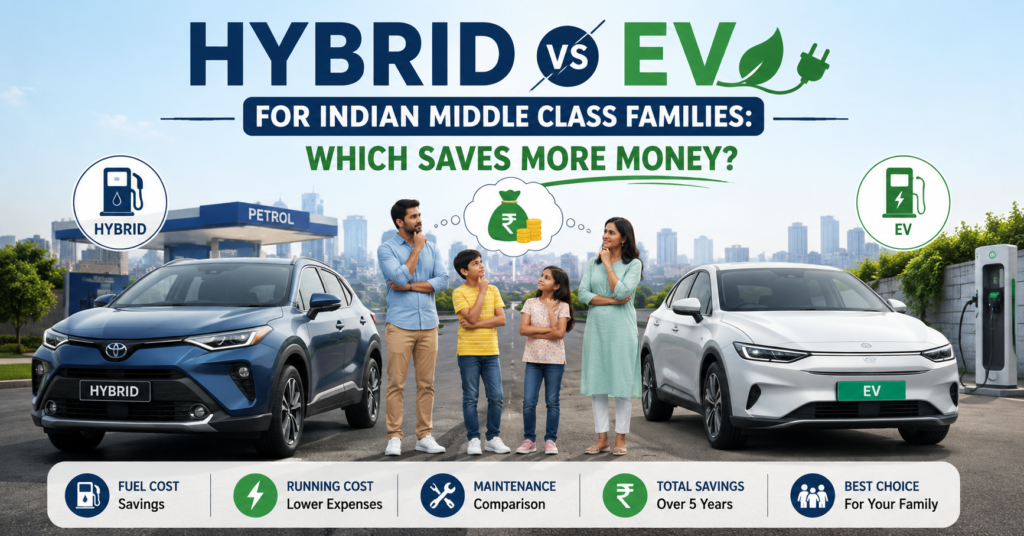
Buying a car in India is a major financial decision for middle-class families. Earlier, the choice was simple – petrol or diesel. But now, buyers are increasingly confused between hybrid cars and electric vehicles (EVs).
Electric cars promise low running costs and eco-friendly driving, while hybrid cars offer better fuel efficiency without depending fully on charging infrastructure. Both seem attractive, but which one actually saves more money for Indian families?
The answer depends on your daily travel, city infrastructure, long-distance usage, and overall lifestyle. Let’s compare hybrids and EVs from a practical Indian middle-class perspective.
Why Indian Middle-Class Families Are Confused Between Hybrids and EVs
Many Indian buyers are stuck between two fears:
- EV buyers worry about charging availability, battery replacement, and long-distance travel.
- Hybrid buyers worry whether spending extra on hybrid technology is truly worth it.
At the same time, fuel prices continue to rise, and governments are pushing electric mobility aggressively. Social media, YouTube reviews, and advertisements make EVs look like the future, while automobile experts often say hybrids are more practical for India right now.
For middle-class families, the confusion becomes even bigger because:
- Budgets are limited
- One car usually handles all family needs
- Reliability matters more than trends
- Unexpected expenses can create financial stress
This is why many buyers are now asking:
“Should we choose a hybrid for convenience or an EV for lower running costs?”
Which Is Cheaper to Own in the Long Run?
The total ownership cost includes:
- Purchase price
- Fuel or electricity cost
- Maintenance
- Insurance
- Battery replacement
- Resale value
At first glance, EVs appear cheaper because electricity costs less than petrol. However, the actual answer depends heavily on usage patterns.
Initial Purchase Cost
In India, strong hybrid cars are usually expensive up front. EVs can also be costly, but government subsidies sometimes reduce prices.
For example:
- Mid-range EVs often cost between ₹10–20 lakh
- Strong hybrids may cost ₹15–25 lakh
For budget-conscious families, the higher upfront cost itself becomes a major consideration.
Maintenance Costs
EVs generally have:
- Fewer moving parts
- No engine oil changes
- Lower servicing requirements
Hybrids still contain:
- Petrol engine
- Electric motor
- Battery system
So maintenance can sometimes be slightly higher than EVs.
However, hybrids are serviced similarly to regular cars, making them easier for smaller cities and towns.
Hybrid vs EV for Long Highway Trips
This is one of the biggest deciding factors for Indian families.
Why Hybrids Feel Stress-Free
Hybrid cars behave almost like normal petrol cars. You simply refuel and continue driving.
Advantages:
- No charging stops
- Better highway confidence
- Easier travel to villages and smaller towns
- Less route planning
For families who frequently travel long distances, hybrids often feel more practical.
EV Highway Challenges
Electric vehicles perform very well inside cities, but highway travel can still create anxiety.
Common concerns include:
- Limited charging stations
- Long charging times
- Charger compatibility issues
- Fear of battery draining mid-trip
Although India’s charging network is improving, many families still hesitate to depend fully on EVs for vacations or emergency travel.
EV Charging Challenges in Indian Cities
Charging is one of the biggest real-world challenges for EV ownership in India.
Apartment Living Problems
Many middle-class families live in:
- Apartments
- Gated communities
- Rented homes
Installing a personal charger may not always be easy due to:
- Parking limitations
- Society approvals
- Shared electrical systems
Without home charging, EV ownership becomes less convenient.
Public Charging Issues
Public charging stations are increasing, but users still report:
- Long waiting times
- Broken chargers
- Slow charging speeds
- Poor charger availability during peak hours
For someone with a hectic office schedule, these problems can become frustrating over time.
Power Cuts and Electricity Reliability
In some areas, power cuts still remain common. This creates another layer of uncertainty for EV users.
Hybrids avoid this problem completely because they do not rely fully on the charging infrastructure.
Fuel Savings vs Electricity Savings
This is where EVs usually shine.
EV Running Costs
Charging an EV typically costs much less than filling up with petrol regularly.
For example:
- Petrol cars may cost ₹6–10 per km
- EVs can sometimes run at ₹1–2 per km
Families with:
- Daily office commutes
- Frequent city driving
- Heavy monthly usage
can save substantial money with EVs over time.
Hybrid Fuel Savings
Hybrid cars are far more fuel-efficient than regular petrol vehicles.
In city traffic, hybrids use electric assistance frequently, helping reduce fuel consumption significantly.
However, hybrids still require petrol, so running costs are usually higher than those of EVs.
Who Saves More?
- High daily city usage → EV usually saves more
- Mixed city + highway travel → Hybrid may feel more practical
- Limited charging access → Hybrid becomes easier to manage
Battery Replacement Costs Explained
Battery replacement is one of the biggest fears among Indian buyers.
EV Battery Costs
EV batteries are expensive. Replacing them outside warranty can cost several lakhs, depending on the vehicle.
However:
- Most manufacturers provide long battery warranties
- Modern batteries are designed to last many years
- Battery technology is improving rapidly
Still, uncertainty around long-term battery health worries many middle-class families.
Hybrid Battery Costs
Hybrid batteries are smaller than EV batteries and usually cheaper to replace.
Additionally:
- Hybrids place less stress on batteries
- Battery degradation may happen more slowly
- Replacement costs are often lower than full EV battery packs
For cautious buyers, this creates psychological comfort.
Resale Value: Hybrid vs EV
Resale value is extremely important for middle-class buyers because cars are often upgraded after several years.
EV Resale Concerns
The used EV market in India is still developing.
Buyers often worry about:
- Battery condition
- Future battery replacement costs
- Rapidly changing technology
This uncertainty can affect resale prices.
Hybrid Resale Advantage
Hybrids may currently feel safer in the used market because:
- Buyers understand petrol-based vehicles better
- Fuel stations are available everywhere
- No charging dependency exists
However, this could change in the future as EV adoption increases.
How Indian Traffic Conditions Affect EVs and Hybrids
Indian roads are unique:
- Heavy traffic
- Frequent braking
- Slow-moving city conditions
- Poor road infrastructure in some areas
Interestingly, both hybrids and EVs perform well in traffic.
Why EVs Work Well in Cities
EVs are excellent in stop-and-go traffic because:
- Instant torque improves smoothness
- No clutch operation reduces fatigue
- Regenerative braking improves efficiency
Daily commuters may love the silent driving experience.
Why Hybrids Also Excel
Hybrids automatically switch between petrol and electric power in traffic, improving mileage significantly.
Families who:
- Face daily traffic
- Cannot install chargers
- Want fuel savings without lifestyle changes
often find hybrids extremely practical.
Final Verdict: Which Saves More Money for Indian Middle-Class Families?
There is no universal winner because every family’s needs are different.
Choose an EV if:
- You drive mostly inside cities
- You have reliable home charging
- Your monthly driving is high
- You want the lowest running cost possible
Choose a Hybrid if:
- You frequently travel long distances
- Charging access is uncertain
- You want flexibility without range anxiety
- You prefer a smoother transition from petrol cars
For many Indian middle-class families today, hybrids currently feel safer and more practical. But for heavy city users with proper charging access, EVs can deliver bigger long-term savings.
The smartest choice is not about trends – it’s about choosing the vehicle that best fits your real lifestyle, travel habits, and financial comfort.