
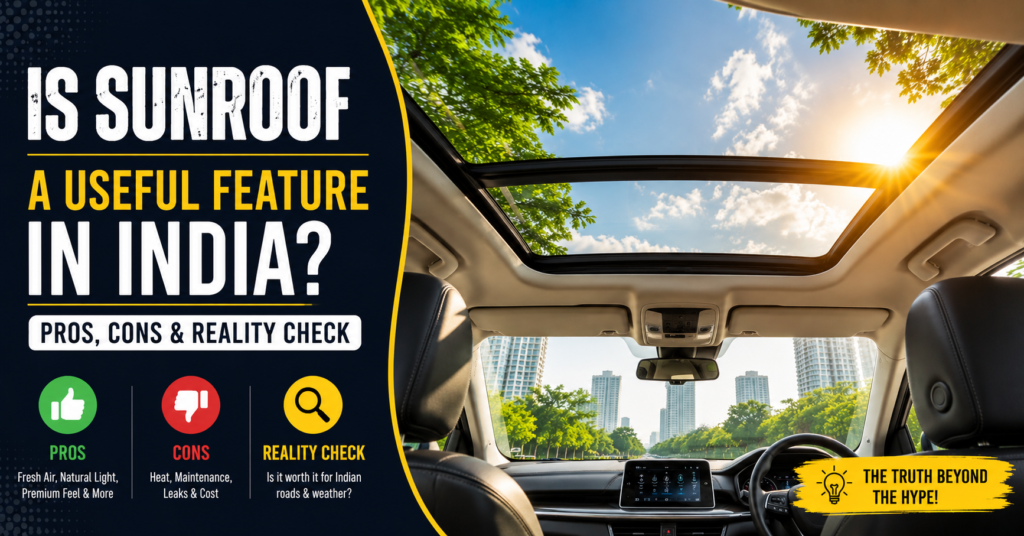
Over the last few years, sunroofs have transformed from a luxury feature into one of the biggest selling points in the Indian car market. Today, many buyers specifically ask whether a car has a sunroof before even checking engine performance, mileage, or safety ratings. Car manufacturers have noticed this trend too, and even budget SUVs now come with electric sunroofs and panoramic roofs.
But the big question remains: is sunroof a useful feature in India, or is it just an expensive gimmick?
The answer is not as straightforward as most advertisements make it seem. For some people, a sunroof genuinely improves the driving experience. For others, it becomes a rarely used feature that increases heat, maintenance costs, and overall car price.
In this article, we will explore the real-world advantages and disadvantages of sunroofs in India, whether panoramic sunroofs are worth the money, and who should actually buy a sunroof car.
Why Are Sunroofs So Popular in India?
A decade ago, sunroofs were mostly seen in premium sedans and luxury SUVs. Today, they have become a status feature even in mid-range vehicles.
There are several reasons why Indians love sunroof cars:
- They make the car look more premium
- Panoramic sunroofs create a spacious cabin feel
- Buyers associate sunroofs with luxury
- Children enjoy standing through the opening while parked
- Social media and advertisements heavily promote them
- Sunroof cars usually have higher showroom appeal
For many buyers, owning a car with a sunroof feels aspirational. It gives the impression of upgrading to a more modern and premium lifestyle.
However, popularity alone does not answer whether a sunroof is actually practical in Indian conditions.
Is Sunroof Useful in India’s Climate?
India’s climate plays a huge role in determining whether a sunroof is worth buying.
Most parts of India experience:
- Intense summer heat
- High humidity
- Dust
- Heavy monsoon rains
Because of this, many people wonder:
Does a sunroof make a car hotter?
The short answer is yes – to some extent.
Even though modern sunroofs use tinted glass and UV protection, glass still absorbs and transfers heat more than a solid metal roof. During peak summer afternoons, especially in cities like Chennai, Delhi, or Hyderabad, panoramic sunroofs can noticeably increase cabin temperature.
As a result:
- The AC may take longer to cool the cabin
- Rear passengers may feel more heat
- The car interior can become hotter when parked outside
This is one of the biggest disadvantages of panoramic sunroofs in India.
That said, the effect depends on:
- The quality of insulation
- Sunshade thickness
- Tinting quality
- Outside temperature
- Whether the roof is panoramic or standard-sized
Premium cars usually manage heat better than budget vehicles.
Advantages of Sunroof Cars
Despite the criticism, sunroofs do offer some genuine benefits.
1. Better Cabin Ambience
One of the biggest advantages of a panoramic sunroof is the feeling of openness it creates. Natural light enters the cabin, making the interior feel bigger and airier.
This is especially noticeable in compact SUVs, where cabin space may otherwise feel tight.
2. Improved Ventilation
A sunroof can help remove trapped hot air quickly.
When parked under the sun, opening the sunroof slightly before turning on the AC can help release heat faster. Some drivers also prefer keeping the sunroof tilted open during cooler evenings for fresh air circulation.
3. Enhanced Driving Experience
Driving through hills, beaches, or scenic roads feels more enjoyable with a sunroof. During pleasant weather, it adds a sense of freedom and openness that regular roofs cannot provide.
This is one reason why many people feel panoramic sunroofs are worth it despite the drawbacks.
4. Premium Feel and Better Resale Appeal
In today’s market, cars with sunroofs often attract more buyer attention.
Since Indian buyers increasingly prefer feature-loaded cars, a sunroof may improve resale desirability, especially in the SUV segment.
Disadvantages of Sunroof in India
Now, let us discuss the downsides that many buyers ignore before purchasing a sunroof car.
1. Increased Cabin Heat
As mentioned earlier, this is the biggest complaint.
During Indian summers:
- Glass roofs absorb sunlight
- The cabin becomes warmer
- AC efficiency may reduce slightly
This becomes more noticeable in panoramic sunroof cars because the glass area is much larger.
Many owners eventually keep the sunshade closed most of the time, defeating the purpose of having a sunroof in the first place.
2. Higher Maintenance Cost
Another major concern is:
Sunroof maintenance cost in India
A sunroof is not just a piece of glass. It includes:
- Motors
- Drainage channels
- Rubber seals
- Electronic controls
- Sliding mechanisms
Over time, these components may require cleaning or repairs.
Common issues include:
- Drainage blockage
- Rattling sounds
- Water leakage
- Motor failure
- Rubber seal wear
Repairing panoramic sunroof mechanisms can be expensive once the vehicle goes out of warranty.
3. Risk of Leakage
One of the most searched concerns online is:
Can sunroof leak in rain?
Yes, poorly maintained or damaged sunroofs can leak.
Heavy monsoon conditions in India increase this risk if:
- Drainage tubes clog
- Seals deteriorate
- The roof is not fully closed
While modern sunroofs are generally reliable, leakage issues are still possible after several years of ownership.
4. Reduced Headroom
Sunroof mechanisms occupy space inside the roof lining.
As a result:
- Tall passengers may lose some headroom
- Rear-seat comfort may reduce slightly
This may not matter for shorter users, but taller passengers sometimes notice the difference.
5. Higher Car Price
Many buyers underestimate how much they are paying for a sunroof.
Sometimes manufacturers bundle the feature only in higher variants. This forces customers to spend significantly more for features they may not actually use.
In some cases, buyers pay:
- ₹1–3 lakhs extra
- higher insurance
- higher replacement costs
Just to get a panoramic sunroof.
Is Panoramic Sunroof Worth It?
A panoramic sunroof covers a much larger portion of the roof compared to a regular sunroof.
It looks impressive and creates a luxury-car feel, but it also comes with additional drawbacks.
Pros of Panoramic Sunroof
- More spacious cabin feel
- Better aesthetics
- Premium appearance
- Excellent for scenic drives
Cons of Panoramic Sunroof
- More cabin heat
- Heavier roof
- Higher repair cost
- Increased replacement expense
- More complicated mechanisms
For many Indian buyers, panoramic sunroofs are more about emotional appeal than practical utility.
If you frequently drive in cool weather, travel long distances, or enjoy road trips, a panoramic sunroof can genuinely improve the experience.
But if you mainly drive in crowded city traffic under extreme heat, you may rarely use it.
Are Sunroofs Safe?
Many people also ask:
Are sunroofs safe during accidents?
Modern sunroofs are generally safe because manufacturers use reinforced tempered or laminated glass. However, there are still some concerns.
Potential risks include:
- glass shattering during severe accidents
- accidental obstruction injuries
- children standing through sunroofs unsafely
- roof strength reduction in some poorly engineered vehicles
The biggest safety issue in India is actually misuse.
Children often stand through moving sunroofs while cars are on public roads. This is extremely dangerous and has caused accidents in several cases.
A sunroof should never be used as a standing platform while driving.
Why Many People Rarely Use Their Sunroof
One interesting reality is that many owners stop using their sunroof regularly after a few months.
Reasons include:
- Excessive heat
- Dust entering the cabin
- Noise at high speeds
- Fear of leakage
- Pollution in cities
- Strong sunlight
Eventually, the sunroof becomes more of a “feature to have” than a feature actively used.
Who Should Buy a Sunroof Car?
A sunroof may be useful for:
- People who enjoy road trips
- Buyers who value premium features
- Drivers in cooler climates
- Families who enjoy scenic travel
- SUV buyers wanting a luxury feel
You may genuinely appreciate the experience if you:
- Travel frequently
- Drive during mornings/evenings
- Prefer airy cabins
- Enjoy premium interiors
Who Should Avoid Sunroof Cars?
You may skip a sunroof if:
- You mostly drive in hot cities
- Mileage and practicality matter more
- You want lower maintenance
- You park outdoors frequently
- You are buying on a strict budget
In many cases, choosing a lower variant without a sunroof but with better safety or engine options may be the smarter decision.
Sunroof vs No Sunroof: Which Is Better?
The answer depends entirely on your priorities.
Choose a Sunroof Car If:
- You value experience and aesthetics
- You enjoy luxury features
- You frequently travel
- You want a modern, premium SUV feel
Choose No Sunroof If:
- Practicality matters most
- You want lower maintenance
- You live in extremely hot areas
- You want maximum headroom
- You want better value for money
Neither choice is universally right or wrong.
Final Verdict: Is Sunroof a Useful Feature in India?
So, is sunroof useful in India?
Yes, but mostly as a lifestyle and comfort feature rather than a necessity.
A sunroof can improve cabin ambience, make drives more enjoyable, and add a premium feel to the car. However, in Indian weather conditions, it also brings compromises like additional heat, maintenance concerns, and higher costs.
For most buyers, a sunroof is not an essential feature. It is something you buy because you enjoy the experience, not because you truly need it.
If your budget allows it and you genuinely love the feature, there is nothing wrong with choosing a sunroof car.
But if you are sacrificing:
- safety features
- engine performance
- fuel efficiency
- or overall value
Just to get a panoramic sunroof, then it may not be worth it.
At the end of the day, the best car is the one that fits your actual driving needs – not just showroom trends.