
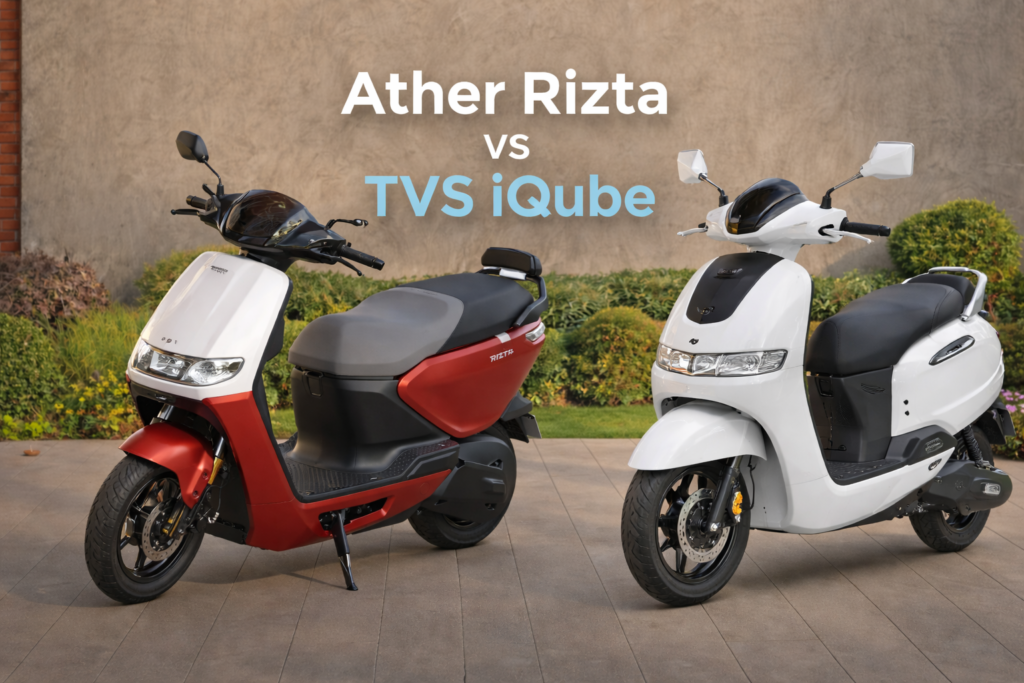
If you are looking for a scooter under 1.5 lakh on road and you have narrowed it down to the EV option due to rising fuel prices and uncertainty of the war conditions in the Gulf countries, then my friend, you have two choices in terms of better range and brand value. We can say that there are other options too, but when we look at the sales figures of all EV scooters, these two scooters top the charts. So let’s start the EV faceoff, iQube vs Rizta.
1. In terms of Design and Chassis
TVS iQube
Kerb weight: 119 kg
Boot capacity: 30 litres
Front brake: Disc 220 mm
Rear brake: Drum 130 mm
The TVS iQube uses a tubular structure frame, which is a little old school, but it does the job. With a 119 kg dry kerb weight, iQube is a lightweight scooter that is comfortable for an individual and can also accommodate a pillion who is not too fat. The under-seat boot space is 30 litres and can fit a small helmet. Due to its lightweight, iQube manages the city commuting better. Combined with a soft suspension setup, it can easily navigate into tight spaces, but its load-carrying capacity is not as good as Ather’s. At the end of the day, you can use iQube as your daily office commuter with ease.
Ather Rizta
Kerb weight: 125 kg
Boot capacity: 34 litres
Front brake: Disc 200 mm
Rear brake: Drum 130 mm
Ather Rizta is a heavy-duty scooter; its broad rear seat can accommodate two adults with ease. Rizta too uses the same tubular chassis, but Ather has upgraded the structure with more high-tensile steel to increase its load-carrying capacity up to 175 kg (Rider + Pillion + Luggage). In Rizta, you can carry up to two giant 20-litre watercans between your feet and the handlebars. Regarding suspension, Rizta has the harder setup since the rear monoshock is firm and doesn’t absorb the dumps like the iQube. Rizta is a little hard to manage in city traffic due to its long, narrow body, but it’s the perfect scooter for people who prefer a heavy-duty scooter, like gig workers.
2. In terms of Electric Motor and Battery
TVS iQube
Motor type: BLDC (Brushless DC)
Drive type: Hub-mounted
Peak Power: 4.0 kW
Peak Torque: 140 Nm
Battery Capacity: 2.2 kWh, 3.1 kWh, 3.5 kWh, 5.3 kWh
iQube uses a Hub-mounted BLDC motor, which is quieter and more reliable compared to the belt-driven setup in Ather. As the motor is directly connected to the rear wheel, torque delivery is instant and has a peak power of 4.0 kW, which makes the iQube a pocket rocket. But its load capacity purely depends on the battery pack. With the 2.2 kWh battery option, the iQube loses its steam early and needs regular charging. The 3.5 kWh and 5.3 kWh battery packs are the best options, but the cost of these battery packs doesn’t make iQube a budget-friendly choice. You get a smaller scooter with a big battery pack compared to the Ather Rizta, which is more spacious ergonomically.
Ather Rizta
Motor type: PMSM (Permanent Magnet Synchronous Motor)
Drive type: Belt driven
Peak power: 4.3 kW
Peak torque: 22 Nm
Battery capacity: 2.7 kWh, 2.9 kWh and 3.7 kWh
Ather has used the more advanced PMSM motor known for performance. As the motor is mounted in the middle of the frame and uses a belt to deliver the torque to the rear wheel, it makes the typical belt sound in all of Ather EVs. The belt setup is not as reliable as the hub-mounted setup, but the cost of replacing a belt is way cheaper compared to the entire Hub. So Ather has played well in terms of maintenance. With 22 Nm of realistic torque and 4.3 kW peak power, Rizta just floats like a butterfly and carries heavy loads with ease. Rizta’s battery capacity starts from 2.9 kWh to 3.7 kWh, which is less compared to iQube.
3. In terms of Charging and Range
TVS iQube
Minimum Range: 75 km for a 2.2 kWh battery
Maximum Range: 212 km for a 5.3 kWh battery
Fast charging: Yes (1500 W)
Default charging: 650 W
Charging time: 80% charge in 4.5 hrs
Maximum speed: 75 kmph
iQube provides more variants on the basis of battery capacity. On the battery management software side, TVS still lacks the punch. The calibration of range and charge percentage is not as efficient as that of Ather. There are a few software glitches faced by customers from time to time, like the Bluetooth connectivity issue, improper range displayed, charging time variations, etc. The 1500 W fast charging feature has made TVS outrun the competition with 80% charge in 2.5 hrs.
Ather Rizta
Minimum range: 94 km for a 2.7 kWh battery
Maximum range: 150 km for a 3.7 kWh battery
Fast charging: No (only 700 W on top variant)
Default charging: 350 W
Charging time: 80% charge in 6.5 hrs
Maximum speed: 80 kmph
Rizta has a total of three variants based on battery capacity, with 2.7 kWh being the most VFM variant. Ather still has not unleashed the fast charging feature in Rizta, with only 700 W, it takes 4.5 hr to reach 80% charge. But the Rizta excels in battery management software with regular updates. Ather has developed an efficient software with better calibration of charge and range. It also provides tech-heavy features (SkidControl, Google Maps) compared to iQube.
4. Maintenance and Reliability
TVS iQube
Warranty on motor and control unit = 5 years
Warranty on battery = 3 years or 50000 kms
TVS is a 2-wheeler giant with service stations spread across tier 1, 2 and 3 cities pan India. TVS spares are easily available in third-party stores, which makes the maintenance part more feasible and budget-friendly. With years of R&D, TVS has built one of the best supply chains in India. The only area where TVS lags is the software side, which TVS has already addressed through recent firm updates.
Ather Rizta
Motor warranty: 3 years or 30000 km
Battery warranty: 8 years or 80000 km
Ather is the new kid in town. With innovations and rigorous R&D, Ather has positioned itself more as a tech company rather than a 2-wheeler manufacturer. Ather is yet to reach tier 2 and tier 3 towns. Presently, it’s available in all tier 1 cities. Lack of availability of spares has clogged Ather’s service centres recently, and also the lack of skilled technicians.
Ather providing 8 years warranty on the battery is surely a welcome move for buyers who are doubtful in terms of the battery’s future. On the software side, Ather is still the best compared to TVS. It’s a new company that is yet to prove its market share in the coming years.
So the final verdict is that if you need a scooter for daily commuting alone, then the TVS iQube is the best option. On the other hand, if you need a scooter that an entire family can rely on for carrying groceries from market, a spacious rear seat, a bigger boot under the seat and for carrying more load, then it’s Ather Rizta for you. Rizta is an all-rounder; it can be your daily driver as well as your load carrier.
The a2zreviews platform was purely started to help common rational buyers who seek information on products before making a decision to buy them. We are an independent platform who focus on buyers’ knowledge, not on brand values, as each buyer has their own requirements.